
Reviewed · MEXICO CITY TOURS
Private City Tour Mexico City – Best Rated
Mexico City’s historic center packs centuries into a few walkable blocks. In two hours, this private tour takes you from the marble-and-gold Palacio Postal to Aztec ruins, a vast civic square, and the country’s most important church. The scale of the story is the real attraction, with Spanish colonial buildings, modern city life, and Mexico’s pre-Hispanic past sharing the same streets.
I like the private format, since you can ask questions, slow down for photographs, and shape the conversation around your interests. I also like the practical local advice built into the walk. Guides including Brenda, Daniel, Rosa Maria, Joss, and Ricardo have helped visitors choose restaurants, plan later sightseeing, and adjust routes when protests, parades, or heavy crowds blocked the usual path.
The main consideration is pace. This is a walking tour with eight stops in about two hours, and one report mentioned more than 10,000 steps during a day that included the tour. Some stops are brief, and you will not have time for a full museum visit. Think of it as a well-guided introduction, not a substitute for exploring every interior.
Key points to know before booking
- Private attention: Only your group participates, so questions and pacing are easier to manage.
- A strong first-day route: The walk links Bellas Artes, grand historic buildings, Templo Mayor, the Zócalo, and the Metropolitan Cathedral.
- English-speaking guides: Guides such as Brenda, Arthur, Diana, Daniel, Rosa Maria, and Joss lead the experience in English.
- A useful two-hour overview: You get the city center’s main story without giving up an entire day.
- Walking is central: There is no private transportation included, and the route can involve substantial time on foot.
- Good local orientation: Guides can offer suggestions for restaurants and other sights for the rest of your stay.
Why this short private walk works well in Mexico City
At $35 per person, this tour is priced less like a full-day private outing and more like a smart orientation walk. The value comes from the guide’s ability to connect places that can seem unrelated when you visit them alone.
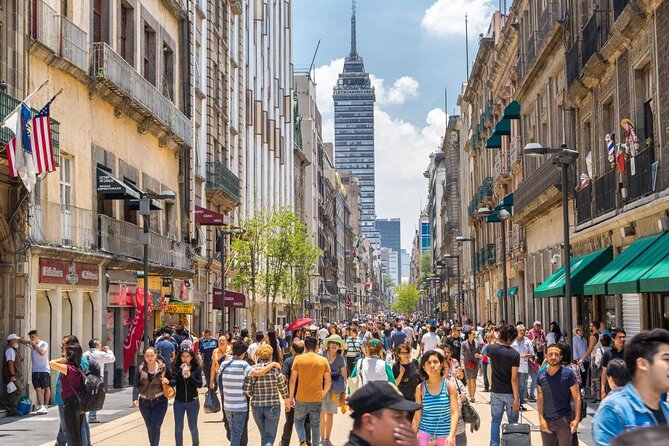
Mexico City’s center is easy to reach by public transportation, but it is not always easy to read. A grand post office, a former mining school, a pastry shop, an Aztec temple site, and a cathedral can all appear within a short walk. Without context, you may notice the façades but miss the long sequence of civilizations and political changes behind them.
A private guide gives you a person to question as the city unfolds. You can ask why a building looks European, how the Aztec capital relates to today’s street plan, or which museums deserve your time later. That flexibility is especially useful if you are visiting Mexico City for the first time.
The two-hour length is another strength. You get enough material to understand the historic center, but you are not locked into a long lecture or a full-day schedule. One guide, Ernesto, helped first-time visitors form plans for the next few days, while another, Arthur, offered advice on which attractions and restaurants were worth pursuing afterward.
Book this early in your stay if you can. The route gives you a mental map, and the recommendations may help you use the rest of your visit better.
More City Tours in Mexico City
- Mexico City: Teotihuacan, Tlatelolco & Guadalupe Shrine Tour
★ 4.6 · 3,773 reviews - Teotihuacan Hot Air Balloon Flight from Mexico City / Volare
★ 5.0 · 3,262 reviews - Teotihuacan Private Tour from Mexico City
★ 5.0 · 1,890 reviews
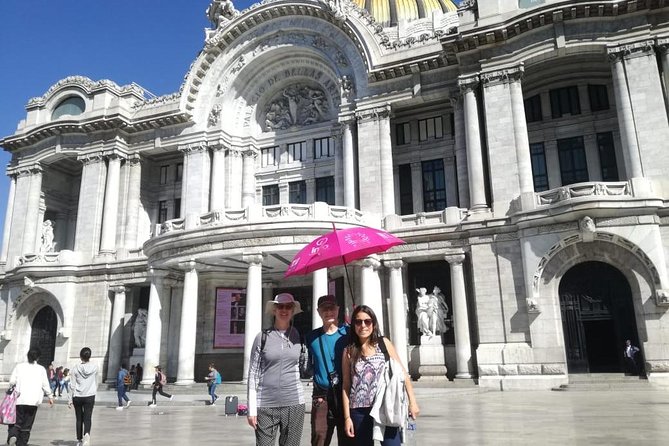
Starting beneath the Palacio de Bellas Artes
The meeting point is outside the Palacio de Bellas Artes on Avenida Juárez. This is a convenient and memorable place to begin, though you should allow time to locate the exact meeting area in the Centro Histórico.
The tour opens with an introduction to Mexico City and the palace. Bellas Artes is more than a pretty white building. It is tied to the country’s art life, and the guide uses it to explain Mexico’s artistic traditions and the role of the building in the city.
You should expect about 15 minutes here, with admission listed as free. That time is enough for an outside explanation and photographs, but not for a full look at the interior art spaces. If the palace is a major priority for you, plan a separate visit.
From this point, the tour begins to show one of Mexico City’s defining traits: buildings from different eras stand close together, each with its own materials, style, and political story. The walk is not simply a parade of monuments. It is a lesson in how the city has been rebuilt and adapted over time.
Palacio Postal and the survival of the historic center
The Palacio Postal is one of the walk’s most rewarding visual stops. Italian marble and gold decoration give the working post office an unusually grand interior and exterior. Yes, it still functions as a post office, which makes the place more interesting than a preserved shell.
The visit lasts about 15 minutes, with admission listed as free. Your guide can point out the building’s decorative details and explain why it matters in the city’s architectural story. This is a good place to slow down for photographs, since the ornate design rewards close attention.
The itinerary also refers to a former tallest building in Latin America that has survived three major earthquakes. The supplied details do not clearly identify this stop by name, so your guide will need to explain exactly which building is being discussed and where it fits into the route. The earthquake point is a useful reminder that Mexico City’s grand center has had to endure serious natural forces as well as constant urban change.
Palacio de Minería and the Caballito viewpoint
Palacio de Minería was built in 1797 and originally served as a mining school. Its history reflects the technical and educational ambitions of colonial Mexico, while its location keeps you close to the city’s major cultural buildings.
The scheduled stop is short, about five minutes. That tells you how to use it: listen closely to the explanation, take a few photographs, and do not expect an extended architectural visit.
Nearby, the route includes a square by the National Art Museum and the statue of El Caballito, the equestrian figure of Charles IV. The statue’s pose and the surrounding architecture offer another chance to talk about Spanish rule, public art, and the way Mexico City presents its past.
This part of the walk is particularly helpful if you enjoy architecture. Your guide can turn a quick look at a façade or monument into a clearer account of how the center was planned and used. If you prefer lengthy museum time, however, the short stop may feel hurried.
A few other Mexico City days to price up
- Mexico City: Teotihuacan Early or Afternoon Access Tour
★ 4.6 · 1,547 reviews - Historic Center Food Tour in Mexico City
★ 5.0 · 1,263 reviews - The best tour to Teotihuacán from Mexico City
★ 5.0 · 1,236 reviews - From Mexico City: Puebla, Cholula and Tonantzintla Day Trip
★ 4.3 · 1,191 reviews
The House of Tiles, a quick look inside
The House of Tiles is one of the easiest stops to recognize. Its blue-and-white tiled façade gives it a distinct appearance, while the interior adds murals, frescoes, and sculptures.
The scheduled visit is about 15 minutes, and admission is listed as included. That makes it more than a photo stop, though the available time still limits how much you can examine. Your guide’s role is important here because the building’s decoration can otherwise become a quick snapshot before you move on.
I like this stop for the contrast it provides. Bellas Artes is monumental, Palacio Postal is ornate and metallic, and the House of Tiles feels more intimate and decorative. Together, the buildings make the center’s architecture easier to remember.
Admission details can change. One account noted that some sites now charge an entrance fee, even where the advertised route lists admission as free or included. If a particular interior matters to you, ask your guide or the operator about current fees before the tour.
Pastelería Ideal and a taste of Mexican baking
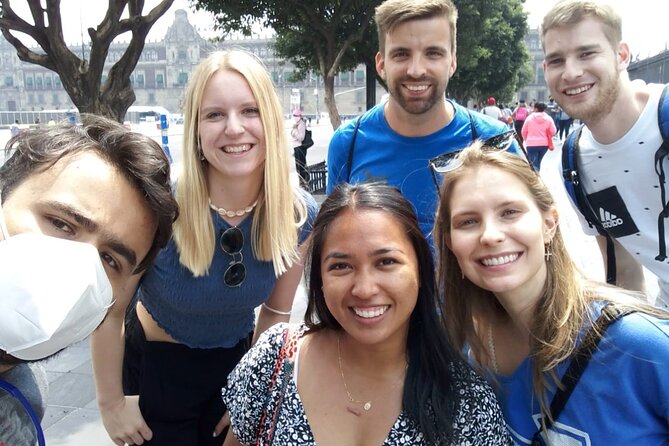
Pastelería Ideal adds a welcome change of pace. This historic pastry shop lets you learn about Mexican baked goods and try some for yourself.
The stop lasts about 10 minutes. It is not a cooking class or a long meal, but it gives the walk a local food angle. After several palaces and monuments, tasting a pastry helps connect the city’s history with everyday life.
I would treat this as a small tasting rather than breakfast or lunch. If you have dietary restrictions, ask what is available before choosing anything. The tour information does not specify the pastries, ingredients, or amount included, so do not book it expecting a full food tour.
Still, this is exactly the sort of short stop that makes a city orientation more memorable. You get a sense of the historic center as a place where people work, shop, eat, and pass through, not only as an open-air museum.
Templo Mayor and the Aztec city beneath today’s streets
At the Museo del Templo Mayor, you reach a real Aztec ruin in the middle of modern Mexico City. The stop is listed as about five minutes, with admission free for the tour.
That short time is enough for an introduction to the ancient civilizations of Mexico, but not enough to explore the museum properly. The site deserves a separate visit if you want to see its archaeological objects and understand the full scale of the excavation.
Even a brief explanation here changes how you see the rest of the center. The colonial buildings and cathedral are not the beginning of Mexico City’s story. They were built in a place with an older urban and religious center, and Templo Mayor makes that earlier world physically visible.
Ask questions here. The private setup works especially well at an archaeological site because you can request a clearer explanation of what remains, how the ruins relate to the surrounding plaza, and which parts of the museum deserve your time later.
Zócalo and the center of the center
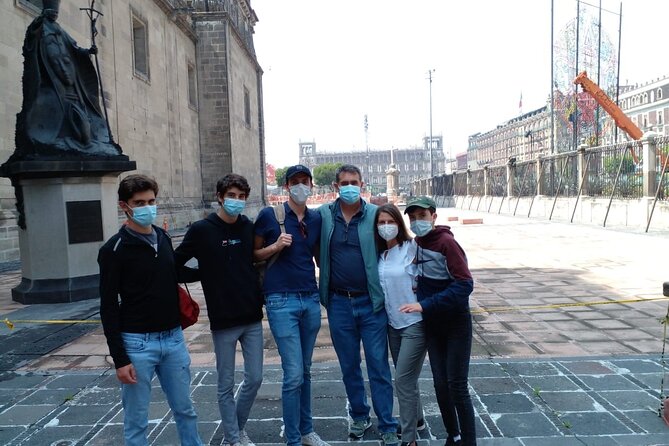
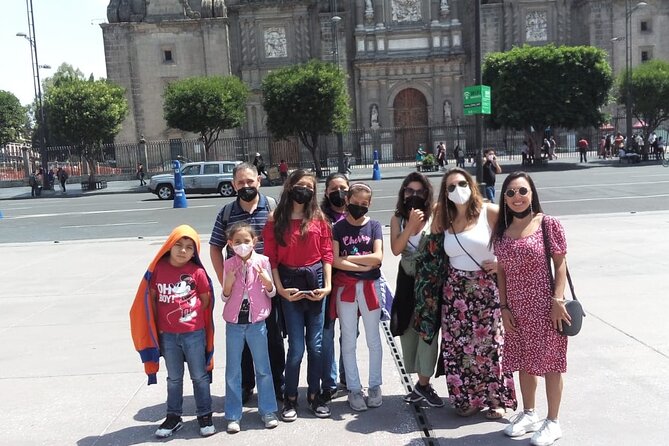
The Zócalo is the tour’s broadest stage. It is described as the largest square in the Western Hemisphere and the second-largest in the world, and it functions as Mexico City’s central civic space.
The scheduled visit is about 20 minutes. Your guide can explain the buildings around the square, its public role, and the political and cultural events that have shaped it. Depending on the day, the open space may be calm or filled with demonstrations, ceremonies, crowds, or temporary activity.
That unpredictability matters. One guide, Rosa, had to change the route during a major protest and helped the group reach an Uber safely. Another guide adjusted the meeting and exit point during a parade. These examples show why a private guide can be useful in the center, where a fixed route may not always be practical.
The Zócalo is also a good place to pause and get your bearings. From here, you can better understand how the cathedral, government buildings, archaeological site, and surrounding streets fit together.
The Metropolitan Cathedral and the final chapter
The Mexico City Metropolitan Cathedral receives about 20 minutes, making it one of the longest stops. It is the country’s most important church and carries stories from religion, architecture, politics, and the city’s changing identity.
The outside alone is imposing, but the scheduled time suggests a focused visit rather than a complete study of every chapel and artwork. Your guide can point out the building’s major features and explain its place beside the Zócalo and Templo Mayor.
This is a strong place to finish because it brings several parts of the route together. You have seen the pre-Hispanic city, colonial institutions, public squares, artistic buildings, and working commercial spaces. The cathedral represents one powerful layer of Mexico City, while the nearby ruins show that the city’s past is far older and more complex.
The activity ends back at the meeting point. That makes it easy to continue sightseeing in the center, return to your hotel, or visit one of the museums you have just heard about.
The guides and the private feel
Guide quality is the strongest part of this experience. The available guide names include Brenda, Arthur, Ricardo, Joss, Diana, Daniel, Rosa Maria, Alejandro, Ernesto, Galy, Ari, Adriana, Jesús, and others.
The praise is consistent in a few useful ways. Brenda is described as a student of Mexican history who made the city engaging and helped with photographs. Daniel is repeatedly associated with clear explanations, friendliness, and a relaxed, conversational manner. Diana is noted for fluent English and an easy conversation style.
Rosa Maria is especially useful if you want cultural context alongside architecture. Her subjects have included the city’s landmarks, Day of the Dead, traditional details, restaurants, and local areas to explore. She also adapted a route to include a taco stop for one group.
Joss has sometimes extended the walk without an extra charge, but you should treat that as a guide’s goodwill rather than a promised feature. Adriana even continued socializing with one group for drinks, though that is not part of the scheduled tour.
The private format means you are not sharing the guide with strangers. That can make the tour slower and more personal, though the exact style depends on the guide assigned to you. You can ask for more history, more architecture, food suggestions, or help planning the next day.
Timing, walking, and practical planning
The tour lasts about two hours and is offered in English. Start times can be chosen to fit your vacation schedule, and confirmation is sent when you book. Support through WhatsApp begins at booking, which is useful for meeting-point questions and last-minute communication.
There is no private transportation. You meet at Palacio de Bellas Artes, travel through the center on foot, and finish at the original meeting point. Wear comfortable shoes, keep water handy, and leave room in your schedule for a longer walk if your guide adds context or the route changes.
The route can be affected by demonstrations, parades, traffic, or other public events. That is not necessarily a flaw in the tour. In fact, the private setup gives the guide more room to change plans, meet you at a safer location, or guide you toward easier transportation, as Ricardo and Brenda did in difficult conditions.
Museums may be closed on Mondays, and one group could not enter museum spaces on that day. Since this tour is mainly an orientation walk, a Monday booking can still work, but check opening days if interior access is important to you.
Service animals are allowed, the route is near public transportation, and the information says most people can participate. If you have mobility concerns, ask for current route details before booking because the experience is fundamentally a city walk.
Free cancellation is available until 24 hours before the start time. Changes or cancellations made inside that window are not accepted for a refund.
Who gets the best value from this tour
I would recommend this for first-time visitors who want a clear introduction without giving up a full day. Families can ask questions as they go, couples get a more relaxed private pace, and solo visitors gain a local contact for practical advice.
It is also a good fit if you are unsure how to organize the historic center. The route combines major sights with smaller details, including the pastry shop and the still-working post office. You can use the tour to decide which buildings, museums, restaurants, and neighborhoods deserve more of your time.
You may want something else if you prefer long museum visits, air-conditioned transportation, or a tightly controlled route with no changes. The tour is short, but the walking can be substantial, and some stops receive only five minutes.
Should you book the Mexico City private city tour?
Book it if you want a personal introduction to Centro Histórico for $35 per person, especially near the start of your visit. The combination of private attention, English-language guiding, flexible timing, and practical recommendations gives the price good value.
Go in with the right expectations. You are getting a guided walk through the city’s main layers, not an all-day museum program or private vehicle tour. Wear good shoes, check Monday opening hours, and ask about current entrance charges for any interior you especially want to see.
If your guide is as adaptable as Brenda, Rosa, Ricardo, Daniel, or Joss have been, the tour can do more than show you monuments. It can help you understand where you are, what to see next, and how to spend the rest of your Mexico City stay.
FAQ
How long does the private Mexico City city tour last?
The tour lasts approximately two hours.
Where does the tour begin?
It begins at Palacio de Bellas Artes on Avenida Juárez in Mexico City’s Centro Histórico.
Where does the tour finish?
The activity ends back at the original meeting point at Palacio de Bellas Artes.
Is transportation included?
No. Private transportation is not included. The experience is primarily a walking tour through the historic center.
Is the tour private?
Yes. Only your group participates in the activity.
Is the tour offered in English?
Yes. The tour is offered in English.
Can I cancel for a full refund?
Yes, if you cancel at least 24 hours before the experience start time. Cancellations or changes made less than 24 hours before the start time are not accepted for a refund.
New on the Mexico City list
- Day of the Dead Tour in San Andres Míxquic From Mexico City★ 3.7 · 52 reviews
- Half-Day Tour to Teotihuacan Pyramids from Mexico City★ 5.0 · 53 reviews
- Xochimilco floating gardens, Coyoacan and UNAM murals★ 4.0 · 53 reviews
- Guided Tour of Coyoacan and Leon Trotsky Museum★ 5.0 · 53 reviews
- Gay Side of History through Plazas & Temples★ 4.5 · 53 reviews
- Flavors of Mexico City: A Tasty Urban Expedition★ 4.5 · 53 reviews
- Butterfly Monarch Tour from Mexico City★ 5.0 · 53 reviews
- From Mexico City: Cholula Pyramid & Puebla Small Group Tour★ 4.6 · 54 reviews
Mexico City Tours, compared.
Teotihuacan, Guadalupe Shrine & Tlatelolco Day Tour with Lunch
Read our review →
Xochimilco, Coyoacan and Frida Kahlo with Optional Lunch
Read our review →
Balloon flight + Breakfast in cave + Pyramids + Pick up CDMX.
Read our review →
Teotihuacan pyramids morning or afternoon without tourist traps
Read our review →
Teotihuacan Early Access Guided Tour with optional Lunch
Read our review →
Balloon flight + pick up in CDMX + Breakfast in Cave + Pyramids
Read our review →
Balloon Flight + Cave Breakfast + Pick Up from CDMX or We Fly
Read our review →
Teotihuacan, Tlatelolco & Guadalupe Shrine Tour
Read our review →Browse the lists this tour appears in