
Reviewed · MEXICO CITY TOURS
Walking Tour of the Historic Center of Mexico City
Mexico City’s historic center makes the most sense when you see its layers side by side. This three-hour walk moves from the Mexica capital around the Zócalo to colonial churches, Diego Rivera murals, grand post offices, and the city’s famous blue-and-white House of Tiles. It is a quick way to get your bearings fast.
I like the small maximum of 10 people, which gives guides such as Fernanda, Luis, Alexia, and Nat room to answer questions and adjust the pace. I also like the mix of major sights and useful context, especially the Templo Mayor, the Ministry of Education murals, and the less obvious archaeological window beneath a modern street.
The main consideration is physical. You will walk for about three hours over busy streets, uneven paving, and cobblestones, with limited places to sit. Mexico City’s altitude, strong sun, and occasional crowds can make the walk feel longer than the clock suggests.
Key points to know before you book
- Mexica and colonial Mexico in one walk: The route links Templo Mayor, the cathedral, viceregal plazas, and modern national identity.
- Small English-speaking groups: The tour caps attendance at 10, and guides are identified by green shirts and umbrellas.
- Diego Rivera murals indoors: The Ministry of Education visit includes a look at a major group of Rivera murals, not just an exterior photo stop.
- A strong first-day introduction: You see the Zócalo, Palacio de Bellas Artes, Palacio Postal, and House of Tiles without needing separate transport.
- Mostly an exterior tour: Several important buildings are explained from outside, and some admissions are not included.
- Plan for walking conditions: Wear comfortable shoes, bring sun protection, and allow for a slower pace if anyone in your group has trouble walking.
Why this walk works as a first look at Mexico City
I see this tour as an orientation walk rather than a series of full museum visits. You get the broad story first: the Mexica city, the Spanish conquest, New Spain, independence-era power, revolution, muralism, and present-day city life.
That approach is useful in Mexico City because the historic center can feel visually crowded with information. A cathedral sits beside an archaeological site. A grand government building carries murals about workers and politics. A quiet plaza recalls colonial trade while modern street life continues around it.
The guides bring different personalities to the route. Fernanda is described as warm, funny, and especially good at making the past connect with the present. Luis is praised for his local recommendations and steady pace. Alexia offers thoughtful historical and contemporary commentary, while Nat has been especially patient with questions and different group needs.
English is the offered language, and the guiding style appears conversational rather than academic. You should expect plenty of explanation, but not a detailed architectural lecture at every building.
The published rating is 4.8 from 870 reviews, with 95 percent recommending the experience. That is a strong signal for a basic city introduction, though the route can only offer a short look at each stop.
More City Tours in Mexico City
- Mexico City: Teotihuacan, Tlatelolco & Guadalupe Shrine Tour
★ 4.6 · 3,773 reviews - Teotihuacan Hot Air Balloon Flight from Mexico City / Volare
★ 5.0 · 3,262 reviews - Teotihuacan Private Tour from Mexico City
★ 5.0 · 1,890 reviews
Starting in the Zócalo, the heart of the city
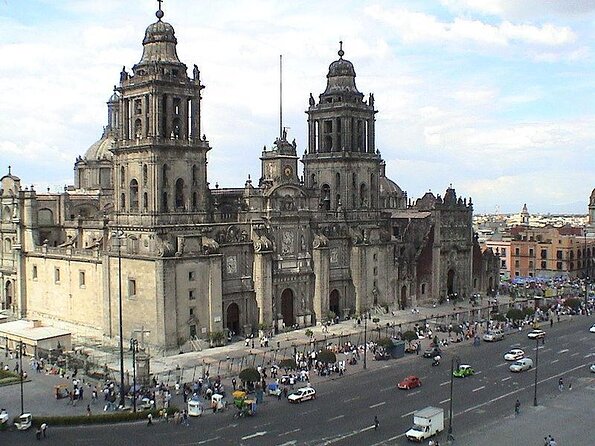
The walk begins at Plaza de la Constitución, better known as the Zócalo. This huge square is the right place to begin because it gathers several forms of power in one view: the National Palace, the Supreme Court of Justice, the Metropolitan Cathedral, and the surrounding shops.
You will hear how the square reflects both the older Mexica center and the Spanish city built over it. The tour does not charge admission for this stop, and the focus is on orientation and explanation rather than entering every surrounding building.
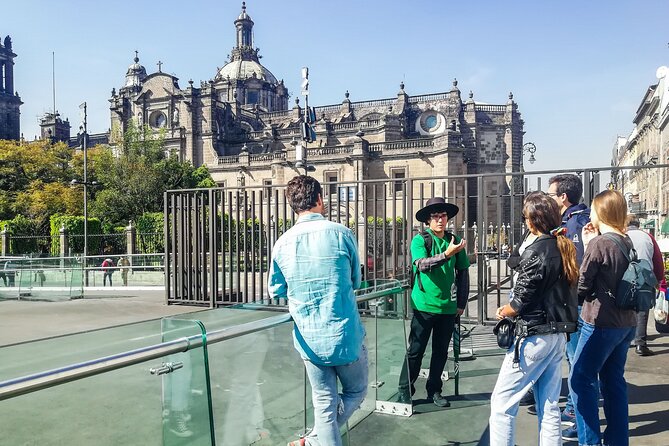
Give yourself a moment to notice the scale. The open plaza can feel grand, exposed, and crowded at the same time. Guides use green shirts and umbrellas, which helps you find the group among the people crossing the square.
This is also where the city’s layers become clear. You are not being led to a preserved colonial quarter separated from modern life. You are standing in a working city center where courts, government offices, shops, worship, demonstrations, and daily errands all share the same space.
The cathedral and Templo Mayor reveal two cities at once
The Metropolitan Cathedral is explained from the outside during a brief stop of about 10 minutes. The guide covers its construction and points out Baroque and neoclassical elements. Since admission is not included, you should treat this as an exterior introduction rather than a cathedral visit.
That limitation is worth knowing in advance. The building deserves more than 10 minutes if you want to study its interiors, chapels, or artwork. Still, the short stop gives you a useful frame for understanding how Spanish religious power reshaped the center.
The route then turns toward the archaeological remains of Templo Mayor. The ruins are viewed from outside, but the stop carries major weight because the temple complex was central to the Mexica capital. The guide explains its connection to the rain god and sun god, its importance to the Mexica, and the layout of the surrounding city.
This is one of the most valuable parts of the walk for first-time visitors. Without context, the ruins can seem like an archaeological patch beside busy streets. With an explanation of the temple’s place in the old city, the site becomes a key to understanding why the modern center looks the way it does.
The route also includes the Ventana Arqueológica, a small archaeological window beneath a street near the main temple. In about five minutes, you learn how older remains were found and why many central buildings conceal earlier layers below them.
It is a short stop, but I like its lesson: the past here is not always displayed in a large museum. Sometimes it appears beneath the pavement, beside a foundation, or through a carefully protected opening.
Diego Rivera’s murals inside the Ministry of Education
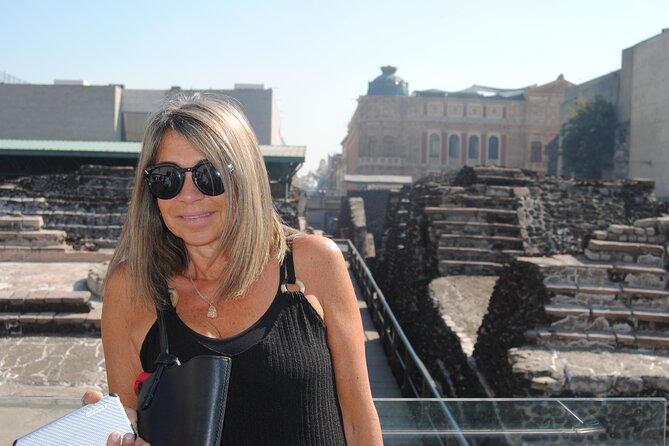
The Museo Vivo del Muralismo visit takes you inside the Ministry of Education for about 25 minutes. This is the main included indoor stop, and it gives the tour a welcome change from plazas and street corners.
The building contains about a third of the murals Diego Rivera painted during his career. The subjects include festivals, traditions, trade, social struggle, and politics in the early 20th century. That range helps you see muralism as more than decoration. The walls present ideas about Mexican identity, work, conflict, and public life.
I would not expect enough time to study every panel closely. Twenty-five minutes is a good sample, not a full museum visit. If Rivera’s work is a major reason for your trip, plan to return independently or spend additional time at a museum devoted to Mexican art.
One useful detail from the experience is that guides may allow a few extra minutes in the building’s courtyards when the group needs them. That flexibility matters here. A rushed mural visit can feel like a missed opportunity, while even a little breathing room makes the stop more rewarding.
More Historical Tours in Mexico City
- Historic Downtown Walking Tour
★ 5.0 · 1,289 reviews - Historic Center Food Tour in Mexico City
★ 5.0 · 1,263 reviews - Mexico City: Historic Downtown Walking Tour
★ 4.8 · 1,039 reviews - Mexico City Historical Centre Food Tour with 7 Authentic Tastings
★ 5.0 · 723 reviews
Santo Domingo and the long reach of New Spain
Plaza de Santo Domingo offers a different kind of history from Templo Mayor and Rivera’s murals. The guide uses this 15-minute stop to discuss major events of the Viceroyalty of New Spain, along with trade in spices and goods from Asia.
The square also opens onto less comfortable subjects, including the Holy Inquisition and France’s attempts to conquer Mexico. This is a useful reminder that Mexico City’s colonial past was shaped by commerce, religion, coercion, and foreign pressure, not just ornate buildings.
The plaza is free to visit, and you will not need a separate ticket for the explanation. The value comes from connecting the architecture to the political and trading systems that once operated here.
Plaza Tolsá is the tour’s pause and conversation point
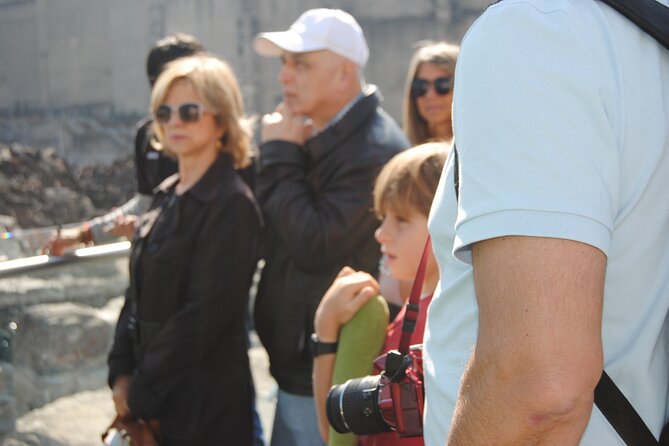
After several historic sites, Plaza Tolsá provides a chance to rest in the shade for about 20 minutes. This is one of the practical strengths of the route. It is not only another photo stop. It gives the guide time to discuss topics that stretch beyond individual buildings.
Possible subjects include Indigenous languages, Day of the Dead traditions, music, politics, and Mexican food. The exact conversation will depend on the guide and the questions from your group. Guides such as Luis are also noted for sharing useful suggestions for the rest of your stay.
The square includes the equestrian statue of Charles IV, often called El Caballito, or the little horse. You also see the exterior of the National Museum of Art and the Mining Palace.
This is a good place to ask questions. I would use it to clarify anything that felt compressed earlier, especially the transition from Mexica rule to Spanish rule and the way modern Mexican identity draws from both Indigenous and European traditions.
Bellas Artes, Palacio Postal, and the House of Tiles
Palacio de Bellas Artes is one of the route’s big visual payoffs. The building’s exterior and interior are described as artistic highlights, though the itinerary treats the stop as a short 15-minute visit with free admission listed.
You should read that carefully. The tour gives you an introduction and a chance to see the building, but 15 minutes is not enough for a full examination of its halls, murals, or exhibitions. If you want a longer visit, return after the walk when you have more time.
The Palacio Postal follows for about 10 minutes. This still-functioning palace is used to explain the economic and political consequences of constructing such a grand public building. Admission is not included, so the stop focuses on the exterior and its story.
That makes the building more interesting than a quick photograph. Its scale and decoration raise a practical question: what did a majestic post office represent about state power, commerce, and a country trying to present itself as modern?
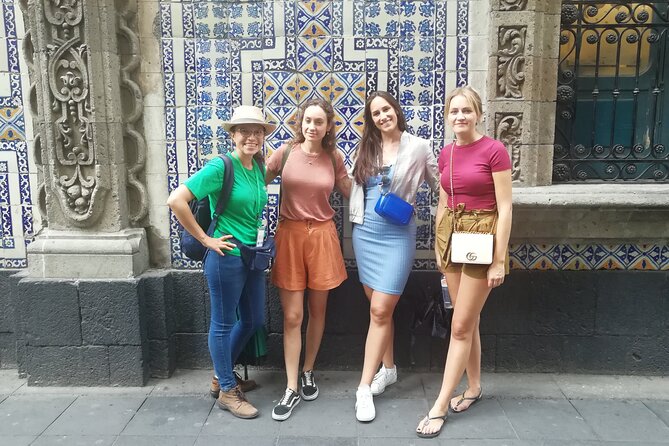
The final major stop is the House of Tiles, one of Mexico City’s most photographed façades. Its tilework has made it an icon of the center, and the free exterior stop is well suited to photographs.
The tour ends near the side of Bellas Artes and the House of Tiles, at Edificio Guardiola on Avenida 5 de Mayo. That location is useful because you finish close to two places worth revisiting, rather than being left far from the main center.
Pace, group size, and walking conditions
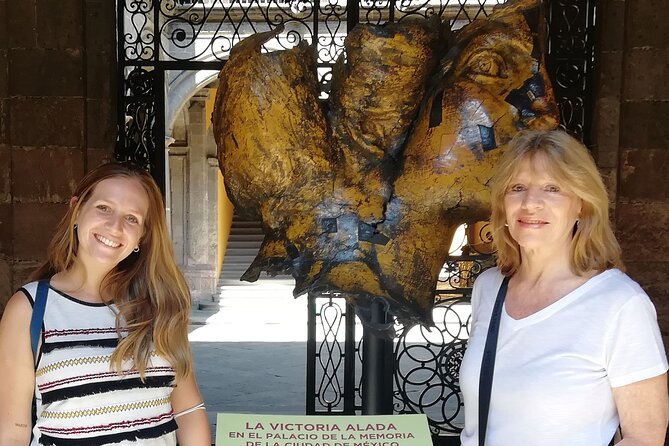
The tour lasts about three hours, with the listed stops adding up to a route that moves steadily from one site to the next. You will spend most of that time standing or walking, not sitting in a coach or inside museums.
The group maximum is 10 people. That is small enough for a guide to hear questions and keep the group together at crossings. It also explains why the pace can be adjusted when the group is only four people, as has happened on some departures.
The downside is that one slow section can affect the whole route. Uneven paving and cobblestones are part of the historic center, and a few people have found that walking difficulties caused the group to miss part of the itinerary. If you have knee, hip, or balance problems, consider how comfortable you are with a three-hour urban walk.
Mexico City’s elevation is another practical concern. One solo participant specifically needed shade and more opportunities to sit, and the guide was attentive to the hot sun. I would wear supportive shoes, carry water, use sunscreen, and bring a hat. A morning or late-afternoon departure may feel easier than walking under the strongest midday sun, but the exact tour time depends on the departure you choose.
The route passes through busy public areas. Guides have been praised for handling street crossings and keeping the group together, but you should still stay alert in crowds and keep valuables secure.
What is included, and where the value lies
The package includes the three-hour guided walk and admission to the Museo Vivo del Muralismo. The cathedral, Templo Mayor, Palacio de Bellas Artes, Palacio Postal, House of Tiles, plazas, and archaeological window are handled as exterior or brief sightseeing stops, with the listed admission details varying by location.
Tips are not included. Some food and sweets available for purchase are also not included, and you must arrange your own transportation to the Zócalo meeting point.
The price is not provided in the information available here, so I cannot judge the exact cost against similar tours. I would judge the value this way: you are paying for an English-speaking guide, a carefully linked route, small-group attention, and the included mural visit, not for a series of expensive entry tickets.
One point needs clarification before you book. The operator is called Kactus Free Walking Tour, and one participant felt the experience resembled a free walking tour where a tip might go directly to a student guide. Since gratuities are listed as excluded and the booking price is not stated here, confirm the payment and tipping arrangement before you commit. That avoids an awkward surprise at the end.
Group discounts are available, so the value may improve if you are booking for several people. Free cancellation is available up to 24 hours before the start time for a full refund. Cancellations or changes within 24 hours are not refunded, and poor weather or failure to meet the minimum group size can lead to a new date or full refund.
Who will get the most from this Mexico City walk
I would choose this tour for a first visit, especially if you want the historic center explained before returning to key buildings on your own. It suits solo visitors, couples, and friends who prefer a small group and want to ask questions as they go.
It is also a good match for English-speaking visitors who want history, architecture, local customs, and present-day context in one outing. The guides’ approach appears to balance dates and buildings with music, food, Indigenous languages, politics, and personal observations about the city.
I would think twice if your goal is a full museum tour or an expert-level study of architecture. Most stops are short, several are outside, and the cathedral and Palacio Postal do not include admission. A separate visit will be better for anyone who wants to spend an hour or more inside each major site.
Families and older people may enjoy the content, but the route still requires good walking ability. Most people can participate, and service animals are allowed, but the cobblestones, heat, elevation, and limited seating deserve attention.
Should you book it?
Book this walking tour if you want a lively first look at Centro Histórico and value a guide who can connect Templo Mayor, colonial power, muralism, and modern Mexico. The strongest reasons are the small group, the included Ministry of Education mural visit, and the guides’ ability to answer questions and adapt the pace.
Skip it if you want long indoor visits, guaranteed access to every building, or a gentle route with frequent seating. For most first-time visitors who can manage three hours on foot, this is a sensible and content-filled introduction. Just bring water, protect yourself from the sun, and confirm the price and tip expectations before booking.
FAQ
How long is the Walking Tour of the Historic Center of Mexico City?
The tour lasts approximately three hours.
Where does the tour begin?
It begins at Plaza de la Constitución, in Centro Histórico, Mexico City.
Where does the tour end?
The tour ends at Edificio Guardiola on Avenida 5 de Mayo, near the Palace of Fine Arts and the House of Tiles.
What language is the tour offered in?
The tour is offered in English.
How many people can join the tour?
The maximum group size is 10 travelers.
Is admission to the Diego Rivera mural visit included?
Yes. Admission to the Museo Vivo del Muralismo is included.
Are cathedral and Palacio Postal admission fees included?
No. Admission to the Metropolitan Cathedral and Palacio Postal is not included.
What happens if I need to cancel?
You can receive a full refund if you cancel at least 24 hours before the experience start time. Cancellations or changes made less than 24 hours before the start time are not refunded.
More Historic Sites in Mexico City
- Mexico City: Guided walking tour through the most historic parts of the city.
★ 4.5 · 172 reviews - Private Walking Tour Gems of the Historic Center of Mexico City
★ 5.0 · 87 reviews - Mexico City: Historical walking tour of Tenochtitlan
★ 4.9 · 69 reviews - 10 wonders of the Historic Center of Mexico City food and music
★ 5.0 · 67 reviews
More Walking Tours in Mexico City
- Frida Kahlo VIP [Museum Tickets Included] Walk, Markets & Churros
★ 5.0 · 982 reviews - Anthropology Museum Private Experience Walking Tour
★ 5.0 · 355 reviews - Walking Tour in Mexico City for Exploring their Cultural Heritage
★ 5.0 · 245 reviews - Walking Tour – Impressive murals in Historical Center of Mexico City
★ 5.0 · 224 reviews
New on the Mexico City list
- Day of the Dead Tour in San Andres Míxquic From Mexico City★ 3.7 · 52 reviews
- Half-Day Tour to Teotihuacan Pyramids from Mexico City★ 5.0 · 53 reviews
- Xochimilco floating gardens, Coyoacan and UNAM murals★ 4.0 · 53 reviews
- Guided Tour of Coyoacan and Leon Trotsky Museum★ 5.0 · 53 reviews
- Gay Side of History through Plazas & Temples★ 4.5 · 53 reviews
- Flavors of Mexico City: A Tasty Urban Expedition★ 4.5 · 53 reviews
- Butterfly Monarch Tour from Mexico City★ 5.0 · 53 reviews
- From Mexico City: Cholula Pyramid & Puebla Small Group Tour★ 4.6 · 54 reviews
Mexico City Tours, compared.
Teotihuacan, Guadalupe Shrine & Tlatelolco Day Tour with Lunch
Read our review →
Xochimilco, Coyoacan and Frida Kahlo with Optional Lunch
Read our review →
Balloon flight + Breakfast in cave + Pyramids + Pick up CDMX.
Read our review →
Teotihuacan pyramids morning or afternoon without tourist traps
Read our review →
Teotihuacan Early Access Guided Tour with optional Lunch
Read our review →
Balloon flight + pick up in CDMX + Breakfast in Cave + Pyramids
Read our review →
Balloon Flight + Cave Breakfast + Pick Up from CDMX or We Fly
Read our review →
Teotihuacan, Tlatelolco & Guadalupe Shrine Tour
Read our review →Browse the lists this tour appears in