
Reviewed · MEXICO CITY TOURS
Walking Tour in Mexico City for Exploring their Cultural Heritage
Mexico City’s historic center is a stack of civilizations, and this walking tour lets you read that story one plaza at a time. You begin at the Zócalo, where Aztec foundations, Spanish power, modern politics, and public celebrations all meet, then walk toward the Palace of Fine Arts.
I like the tour’s compact route and its human scale. You get a useful first look at major sights without spending half a day in a bus, and guides such as Diana, David, Carmina, Sofía, Jesus, and Marco have been praised for clear explanations, lively storytelling, and thoughtful answers. I also like the $25 price, which is fair for a two to three-hour guided introduction.
The main consideration is walking time. You need to manage roughly three hours on foot, often while standing outdoors, and the tour only includes the guide. Food and drinks are not included, and the group can reach 20 people, so a private, slow-paced experience is not guaranteed.
Key points at a glance
- The Zócalo gives you the city’s big picture: Politics, public life, Spanish rule, and the ancient city all begin here.
- Templo Mayor brings Tenochtitlan into view: You see the remains of the central Mexica temple beside the modern city.
- The route moves through several eras: Santo Domingo, the National Art Museum, the House of Tiles, and the Palace of Fine Arts each add a different chapter.
- The guides are the tour’s greatest asset: Diana, David, Carmina, Sofía, Jesus, and Marco have all been praised for strong explanations and open conversations.
- The morning start is practical: At 9:00 a.m., you can get oriented before spending more time in the historic center on your own.
- The walk suits first-time visitors: It offers a useful map in your head, but art specialists may want more time inside individual museums.
Why this short walk works so well in Mexico City
Mexico City’s Centro Histórico can feel confusing at first. Streets change character quickly, grand government buildings sit beside old churches, and traces of the Mexica capital appear beneath the Spanish city. A guide helps you connect those pieces instead of seeing them as unrelated sights.
This route is especially useful at the start of a trip. You see the main civic square, the cathedral, federal government offices, Aztec ruins, colonial architecture, murals, and major art buildings in one morning. It does not try to cover all of Mexico City. Instead, it gives you a strong base for deciding where to return.
The tone also seems to depend on the person leading your group. That is normal for a walking tour, but it matters here because the route itself is straightforward. The best part is the interpretation: how your guide explains the changes in power, religion, art, and public life.
Diana has been singled out for linking art and history, especially while discussing the murals at the Palace of Fine Arts. David has been praised for making a large amount of information feel interactive, while Marco adjusted the pace and added practical food and sightseeing advice at the end. Carmina was especially warm and willing to answer questions, and Jesus brought an entertaining style to the walk.
You should still keep your expectations sensible. This is a broad introduction, not a detailed museum seminar. The stop times are short, and the tour works best when you want context before exploring more deeply on your own.
More City Tours in Mexico City
- Mexico City: Teotihuacan, Tlatelolco & Guadalupe Shrine Tour
★ 4.6 · 3,773 reviews - Teotihuacan Hot Air Balloon Flight from Mexico City / Volare
★ 5.0 · 3,262 reviews - Teotihuacan Private Tour from Mexico City
★ 5.0 · 1,890 reviews
Starting at the Zócalo, Mexico City’s great public room
The meeting point is at Plaza de la Constitución, better known as the Zócalo, at 9:00 a.m. This is a useful place to begin because it explains why Mexico City’s center matters before you move into individual buildings.
The square has long been tied to politics, social movements, traditions, and public festivities. Your guide sets the scene for the city’s origins and explains how the center developed around this important open space. For a first visit, this orientation is worth a lot. It gives you a way to place later sights in time and space.
The Zócalo is also where several layers of Mexico City meet most clearly. The ancient Mexica city once occupied this area, Spanish authorities reshaped it, and the modern federal government still operates nearby. You are not just looking at a square. You are looking at the center of civic life.
The scheduled stop lasts about 30 minutes. That is enough for an explanation and exterior views, but not enough for a long architectural study. Wear shoes that feel good on hard city surfaces, and keep your attention on the guide as the square can be busy.
The cathedral and the seat of federal power
Two important buildings are included around the Zócalo: the cathedral, described as the biggest on the continent, and the country’s most important federal government office.
These sights help explain the Spanish and modern chapters of the city. The cathedral represents the power of the colonial church, while the government building points to Mexico’s continuing political role. Seeing them together makes the Zócalo feel less like a decorative plaza and more like a working center of national life.
The supplied details do not promise a full interior visit to either building, so you should think of this portion as guided orientation and exterior interpretation unless your guide tells you otherwise. That is not a flaw for a first morning. You can return later if one building deserves more time.
Templo Mayor and the world beneath the modern streets
The next major stop is the Museo del Templo Mayor, where you see the ruins of the most important temple in ancient Tenochtitlan. The scheduled visit lasts about 20 minutes, and admission is listed as free.
This is one of the route’s most valuable stops because the ruins make the city’s earlier identity visible. Your guide introduces the Aztecs, or Mexica, and explains the culture tied to this central temple. The site also changes how you look at the surrounding streets. The Spanish colonial center was built over the former Mexica capital, and here that older city is not just an idea in a history book.
Twenty minutes is a quick visit. You will get the main story and a look at the ruins, but not a full museum experience. If ancient Mexico interests you most, plan to return for more time after the walking tour. The short stop works well as an introduction, especially if you are still learning the basic names and sequence of Mexico City’s past.
This is also where a strong guide earns the fee. Bare ruins can be hard to read without context. A clear explanation can show you why the temple mattered and how Mexica culture fits into the city’s larger story.
More Historical Tours in Mexico City
- Historic Downtown Walking Tour
★ 5.0 · 1,289 reviews - Historic Center Food Tour in Mexico City
★ 5.0 · 1,263 reviews - Mexico City: Historic Downtown Walking Tour
★ 4.8 · 1,039 reviews - Walking Tour of the Historic Center of Mexico City
★ 5.0 · 870 reviews
Santo Domingo and the contrast between old Mexico and modern art
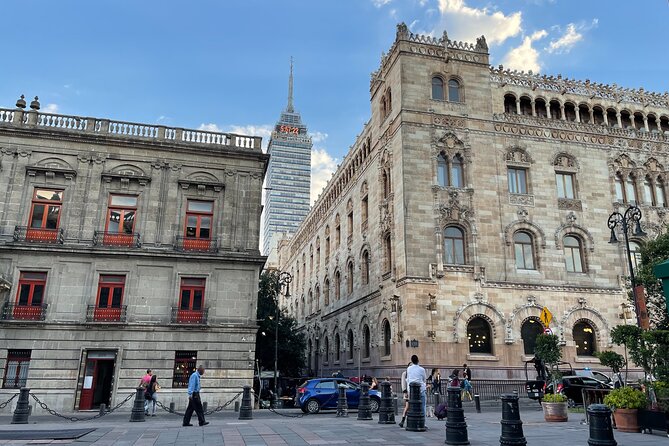
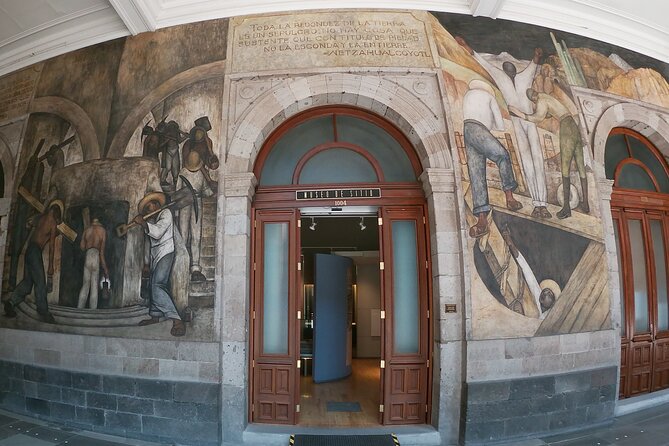
Plaza de Santo Domingo brings a different mood. The tour uses this square to show the contrast between Mexico’s Spanish past and the beginnings of the Mexican muralist movement.
That connection is useful because Mexican art did not appear in isolation. It grew from political change, older traditions, colonial buildings, and public debate. Your guide helps you see how a plaza can tell more than one story at once.
The stop lasts about 30 minutes, giving you enough time to examine the setting and hear the explanation without rushing through it. This is one of the places where questions can make the experience better. Guides have been praised for welcoming questions, so ask if you want to understand how the city’s architecture and art relate to one another.
The word contrast is important here. You move from colonial visual language toward a modern Mexican artistic identity. That shift prepares you for the later discussion of murals and the Palace of Fine Arts.
The National Art Museum and Mexico City’s grand architectural turn
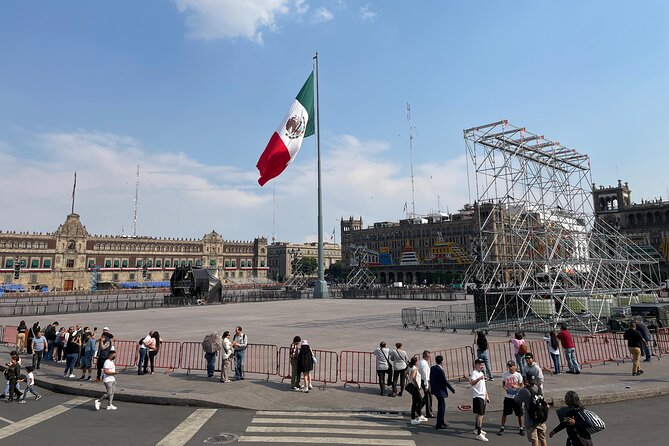
The Museo Nacional de Arte, or MUNAL, is scheduled for about 30 minutes. Here the focus turns to modern architecture from the 20th century and the way it changed the city.
The museum is housed in a grand building, and the point of this stop is not only the collection. The architecture itself becomes part of the lesson. After the Zócalo, Templo Mayor, and Santo Domingo, this stop shows how Mexico City continued to remake its public image in a later era.
Again, thirty minutes gives you an introduction rather than a full museum visit. If you are an art lover, you may want to return separately. For everyone else, the guided explanation helps you notice details you could easily walk past.
Diana’s approach has been particularly effective for people who do not normally think of themselves as art fans. She connected the paintings and murals to the city’s history in a way that made the works easier to understand. That kind of explanation is a real benefit when you have limited time.
The House of Tiles and the road toward Fine Arts
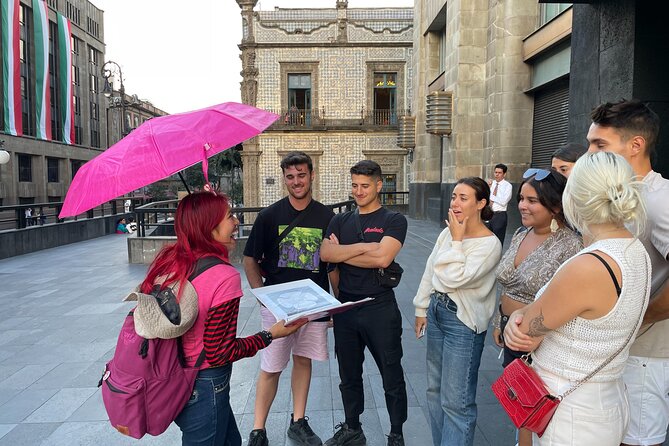
The route also includes a beautiful palace known for its tiles. The supplied information does not give it a separate stop length, but it is part of the walk toward the final destination.
The House of Tiles, known in Spanish as Casa de los Azulejos, adds a lighter architectural moment after the political and historical weight of the earlier sites. Its tiled exterior is easy to appreciate at a glance, but a guide can place it within the changing appearance of the historic center.
You should expect a short exterior look rather than a long visit unless your guide’s timing allows more. That is typical of a route covering many landmarks. The value is in seeing how different buildings share the same central streets while belonging to very different periods.
Finishing near the Palace of Fine Arts
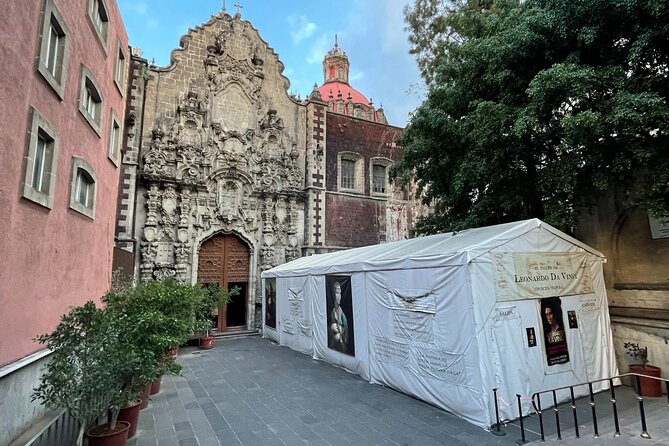
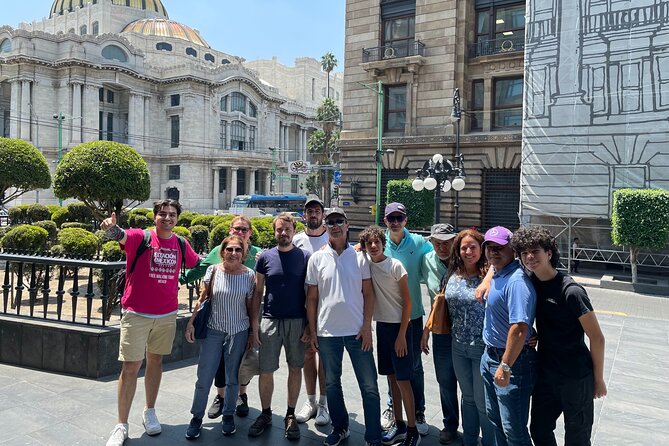
The tour ends near the Palace of Fine Arts at Avenida Juárez 39. This is an excellent finish because the building is one of Mexico City’s most recognizable cultural landmarks, and the surrounding area gives you several options for the rest of your morning.
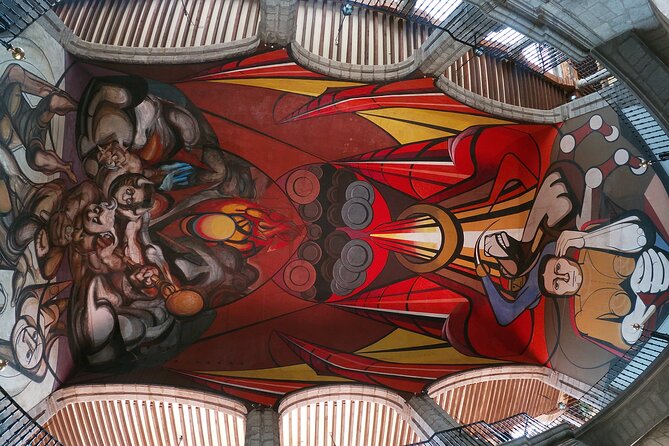
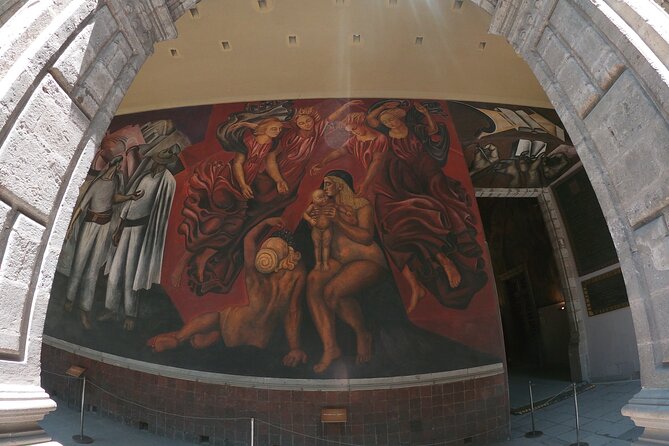
The palace is also where the mural discussion reaches its high point. A guide can help you read the murals as more than large, dramatic images. They reflect ideas about Mexican identity, history, society, and public art. The stop is particularly strong when your guide explains how art and political history meet.
The tour ends close to the palace rather than at the starting point. That matters when planning your day. You can continue exploring nearby instead of walking back across the center, and you can use the orientation from the morning to choose your next stop.
The route details do not state how long you spend inside the Palace of Fine Arts or whether entry to every interior space is included. Treat the finish as a guided stop near the palace and check the arrangements at booking if an interior visit is essential to you.
What the $25 price really buys you
At $25 per person, this is a reasonably priced guided introduction to central Mexico City. The value comes from the route and the interpretation, not from included meals or entry extras. Food and drinks are not included, and the activity lists a tour guide throughout the experience.
For that price, you get two to three hours of structure, historical context, and help noticing the links between major sites. That can save you from spending your first day wandering without a clear sense of what you are seeing.
The value is strongest for first-time visitors, solo visitors, and history lovers who want to ask questions. It is also useful for couples and families looking for a manageable morning activity. If you already know the center well, or if you prefer to spend an hour inside each museum, the pace may feel too broad.
The group can have up to 20 people. That is not a huge group for an urban walk, but it may affect how easily you can speak with the guide. Some past departures have been very small, even private in effect, but you should not count on that.
Timing, meeting point, and walking demands
You meet at Plaza de la Constitución 463 in Centro at 9:00 a.m. The morning start is a plus. It leaves much of the day open and gives you an early framework for the area.
The tour lasts about two to three hours, and you should be able to walk for around three hours. The route includes several plazas and city streets, with periods of standing while the guide explains buildings and events. Comfortable shoes matter more than stylish ones here.
The activity is near public transportation, and most people can participate. Service animals are allowed. Since this is an outdoor urban walk with several stops, think about sun, water, and your own comfort, though the tour does not provide food or drinks.
Mobile tickets make the booking simple, and the tour is offered in English. Confirmation is sent at booking. You can cancel for a full refund up to 24 hours before the start time. Changes or cancellations inside that 24-hour window are not accepted for a refund.
Who should book this historic-center walk?
I would choose this tour for your first day in the Centro Histórico, especially if you want a clear story rather than a list of photo stops. It gives you enough background to make later visits to Templo Mayor, the art museums, or the Palace of Fine Arts more rewarding.
It is a good fit if you enjoy history, architecture, public art, and asking questions. The strongest guide experiences have come from leaders who explain patiently, adjust the pace, and offer practical suggestions about food and further sightseeing.
Families can benefit from the variety. The route changes subject often, moving from ancient ruins to a cathedral, government buildings, plazas, murals, and grand modern architecture. That variety can help hold attention better than a single long museum visit.
You may want another plan if you dislike walking, need a slow accessible pace, or want extensive time inside museums. The activity covers many sights in one morning, so its purpose is orientation. It is not designed to replace a full visit to every museum.
Should you book it?
Book this walking tour if you want a well-priced introduction to Mexico City’s historic center, with a guide who can connect the Zócalo, Templo Mayor, colonial plazas, Mexican art, and the Palace of Fine Arts. The strongest value is the context, especially when your guide brings art and history together.
Skip it if you already know the center well or prefer exploring entirely on your own. For most first-time visitors, though, the short route, English guidance, manageable price, and 9:00 a.m. start make it a sensible way to begin.
FAQ
How much does the walking tour cost?
The price is $25 per person.
How long does the experience last?
The tour lasts approximately two to three hours.
What time does the tour start?
It starts at 9:00 a.m.
Where does the tour begin?
It begins at Plaza de la Constitución 463 in Centro Histórico, Mexico City.
Where does the tour finish?
It finishes at Avenida Juárez 39, close to the Palace of Fine Arts.
Is the tour offered in English?
Yes. English is the listed tour language.
What landmarks are included?
The route includes the Zócalo, the cathedral, a major federal government office, Museo del Templo Mayor, Plaza de Santo Domingo, Museo Nacional de Arte, the House of Tiles, and the Palace of Fine Arts area.
Are food and drinks included?
No. Food and drinks are not included.
How large can the group be?
The tour can have a maximum of 20 travelers.
Can I cancel for a full refund?
Yes, if you cancel at least 24 hours before the experience start time. Cancellations within 24 hours are not refunded.
More Historic Sites in Mexico City
- Mexico City Historical Centre Food Tour with 7 Authentic Tastings
★ 5.0 · 723 reviews - Mexico City: Guided walking tour through the most historic parts of the city.
★ 4.5 · 172 reviews - Private Walking Tour Gems of the Historic Center of Mexico City
★ 5.0 · 87 reviews - Mexico City: Historical walking tour of Tenochtitlan
★ 4.9 · 69 reviews
More Walking Tours in Mexico City
- Frida Kahlo VIP [Museum Tickets Included] Walk, Markets & Churros
★ 5.0 · 982 reviews - Anthropology Museum Private Experience Walking Tour
★ 5.0 · 355 reviews - Walking Tour – Impressive murals in Historical Center of Mexico City
★ 5.0 · 224 reviews - Muralist Art Semi Private Walking Tour in Mexico City Downtown
★ 5.0 · 188 reviews
New on the Mexico City list
- Day of the Dead Tour in San Andres Míxquic From Mexico City★ 3.7 · 52 reviews
- Half-Day Tour to Teotihuacan Pyramids from Mexico City★ 5.0 · 53 reviews
- Xochimilco floating gardens, Coyoacan and UNAM murals★ 4.0 · 53 reviews
- Guided Tour of Coyoacan and Leon Trotsky Museum★ 5.0 · 53 reviews
- Gay Side of History through Plazas & Temples★ 4.5 · 53 reviews
- Flavors of Mexico City: A Tasty Urban Expedition★ 4.5 · 53 reviews
- Butterfly Monarch Tour from Mexico City★ 5.0 · 53 reviews
- From Mexico City: Cholula Pyramid & Puebla Small Group Tour★ 4.6 · 54 reviews
Mexico City Tours, compared.
Teotihuacan, Guadalupe Shrine & Tlatelolco Day Tour with Lunch
Read our review →
Xochimilco, Coyoacan and Frida Kahlo with Optional Lunch
Read our review →
Balloon flight + Breakfast in cave + Pyramids + Pick up CDMX.
Read our review →
Teotihuacan pyramids morning or afternoon without tourist traps
Read our review →
Teotihuacan Early Access Guided Tour with optional Lunch
Read our review →
Balloon flight + pick up in CDMX + Breakfast in Cave + Pyramids
Read our review →
Balloon Flight + Cave Breakfast + Pick Up from CDMX or We Fly
Read our review →
Teotihuacan, Tlatelolco & Guadalupe Shrine Tour
Read our review →Browse the lists this tour appears in