
Reviewed · MEXICO CITY TOURS
Tour Museum of Anthropology a trip to the past-Small groups
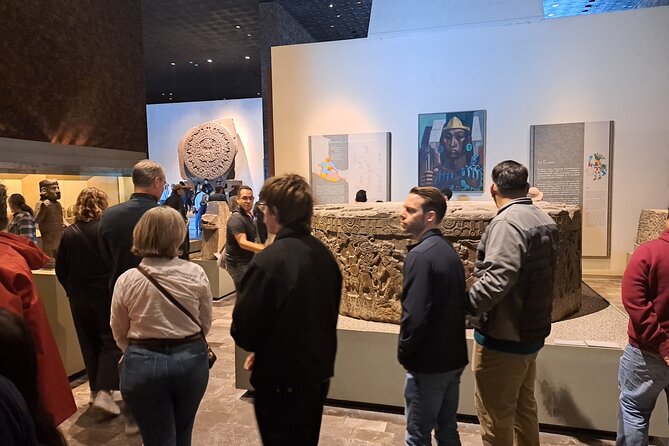
Mexico City’s National Museum of Anthropology is too large to absorb casually. This three-hour small-group tour gives you a clear route through its major rooms, with guides such as Jorge and Delta turning objects into a connected story about Mexico’s ancient peoples.
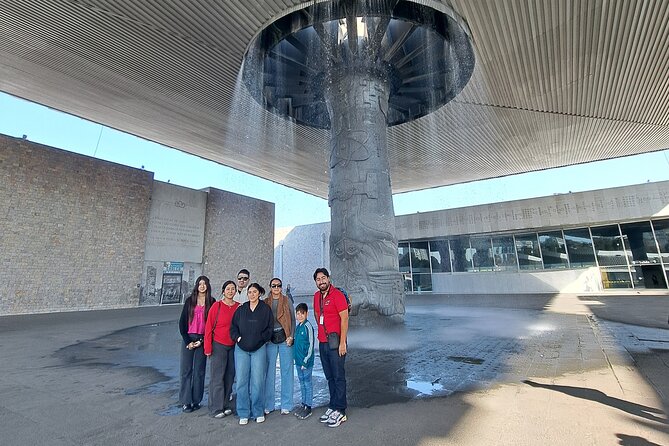
I like the way the tour uses maps, charts, questions, and even a return to the museum’s opening pillar to help you see how symbols fit together. I also like the English guidance, since many exhibit labels are in Spanish and only some have English translations. The tradeoff is simple: three hours covers highlights, not the whole museum, and one unfortunate booking report describes a ticket problem and no guide appearing, so confirm your arrangements carefully.
Key points to know
- A focused route through a huge museum: You see important rooms and objects without wandering aimlessly.
- Jorge and Delta bring different strengths: Both are praised for clear English, strong storytelling, and passion for Mexican culture.
- The Sun Stone and Pakal Sarcophagus are central highlights: The guide explains their symbols and place in a wider timeline.
- Small groups improve the conversation: The maximum group size is 15, with several accounts describing groups of only a few people.
- The tour is an introduction, not a full museum visit: Plan extra time if you want to explore the rooms the tour cannot reach.
- The $98.57 price includes admission and a guide: You are paying for interpretation as much as for entry.
Why this museum needs a three-hour guide
The National Museum of Anthropology is not a quick stop. Its collection covers thousands of years and many cultures, with large galleries, major stone works, maps, timelines, and displays that can be hard to place in order if you are on your own.
I find this kind of museum most useful when someone gives me a framework before the details arrive. Instead of seeing one impressive object after another, you learn how regions, peoples, beliefs, and historical periods connect. That is the main service this tour provides.
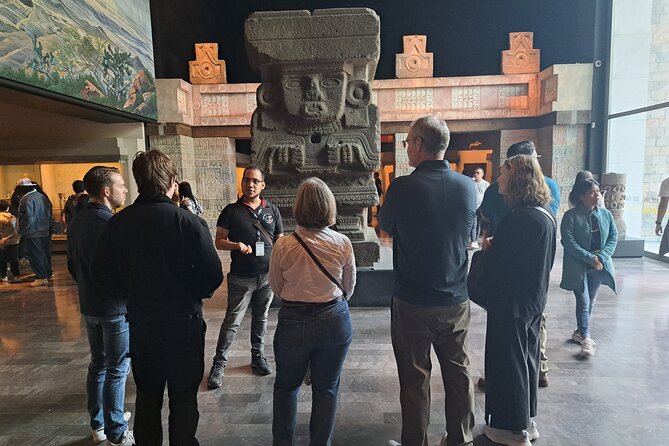
Guides Jorge and Delta are repeatedly praised for making a difficult subject easy to follow in English. Jorge’s approach is especially interactive. He begins with a large pillar and asks you to name what you see, even when the symbols seem unclear. Later, after learning the basic ideas, you return to that same point and recognize far more of what it represents.
That technique matters. You are not simply listening to a lecture and trying to remember dates. You are asked to look, guess, compare, and revise your understanding. For families with teenagers, solo visitors, and anyone who loses focus during standard museum talks, that can make three hours pass quickly.
More Museums in Mexico City
- CDMX: Xochimilco, Coyoacan, Frida Kahlo Museum & Murals Tour
★ 4.4 · 3,025 reviews - Chapultepec Castle & Anthropology Museum Tour
★ 4.5 · 1,348 reviews - Frida Kahlo VIP [Museum Tickets Included] Bike, Markets & Churros
★ 5.0 · 1,072 reviews
Following Mexico’s ancient cultures through objects
The tour focuses on the pre-Hispanic cultures represented in the museum. You might move from one cultural area to another while the guide explains how archaeologists build a picture of societies from buildings, objects, symbols, burial items, maps, and written or visual evidence.
The guide’s job is not only to tell you what an object is. It is to explain why it matters and what can reasonably be known about it. One useful feature of the approach is attention to the difference between proven evidence, later interpretation, and popular legend. That helps you avoid treating every dramatic story as established fact.
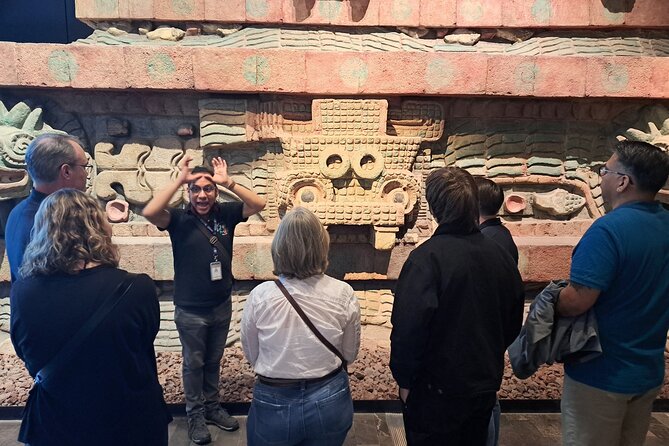
The route also places cultures such as Teotihuacan, the Maya, and the Mexica within a larger sequence. The goal is not to claim that all of ancient Mexico was one single culture. Instead, the guide helps you see contrasts and connections between different peoples and regions.
That broad view is particularly helpful if you plan to visit other archaeological sites in Mexico. The museum can otherwise feel like a collection of unrelated rooms. With a guide, individual objects become reference points for understanding the country’s ancient past.
The Sun Stone, Pakal Sarcophagus, and other major works
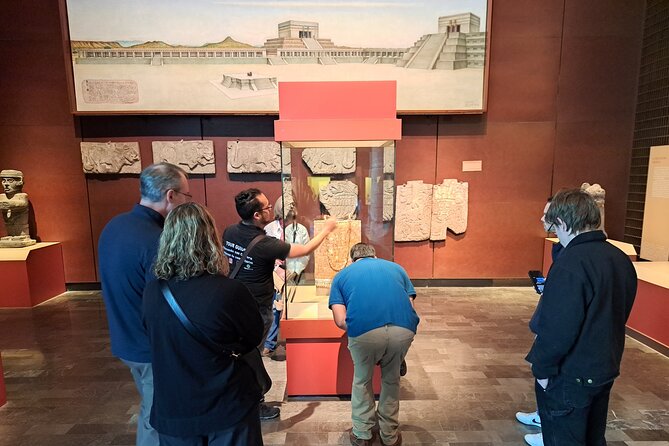
Two named highlights are the Sun Stone and the Pakal Sarcophagus. These are not just famous objects to photograph. Their value comes from the explanation around them, particularly the symbols, beliefs, and political ideas represented in the designs.
The Sun Stone can be visually overwhelming. A guide helps you look at its structure and details rather than treating it as a giant carved disk. The Pakal Sarcophagus gives the tour another chance to examine how an important burial object can be read through imagery, ritual, and the story of a ruler.
The museum also contains objects that are not always displayed in ordinary public areas, along with material connected to restoration work. The tour description presents access to these items and restoration information as part of its special format. Still, the exact pieces available can vary, so I would treat this as a possible bonus rather than the sole reason to book.
A good guide also points out small details that you could easily miss. In a museum this large, interpretation is often more valuable than simply getting through additional rooms. You can look at hundreds of objects alone, yet remember only a few. A focused guide gives those few objects a place in a larger story.
Jorge’s interactive storytelling style
Jorge receives particularly strong praise for linking one object to the next. His method uses questions, maps, charts, and a clear timeline to show how separate pieces of information relate to one another.
That matters for a subject covering roughly 4,000 years. Dates alone are difficult to hold in your head. A story built around questions gives you a reason to care about the next artifact. The guide also raises thoughtful questions about how history is recorded, including the fact that surviving accounts are often shaped by those who held power.
I like that approach because it leaves room for uncertainty. Archaeology does not always provide a complete answer, and a responsible guide can explain what evidence suggests without pretending every mystery is solved.
Jorge’s style is animated and conversational, with enough energy to keep a family group engaged. His English is described as excellent, and an earpiece may be provided so you can hear him clearly. That is useful in a busy gallery, though you should still expect to walk and concentrate for most of the three hours.
More museums around Mexico City:
- Anthropology Museum Guided Tour
★ 4.5 · 1,035 reviews - Frida Kahlo VIP [Museum Tickets Included] Walk, Markets & Churros
★ 5.0 · 982 reviews - EXCLUSIVE TOUR Frida Kahlo Museum – SMALL GROUPS
★ 5.0 · 901 reviews - Mexico City: Anthropology Museum Guided Visit
★ 4.4 · 708 reviews
Delta’s clear route and cultural perspective
Delta’s guiding style is described as friendly, passionate, and highly organized. She takes groups through key rooms and identifies the objects that provide the best foundation for understanding the museum.
Her strength is connecting different timelines and peoples. She can move from Teotihuacan to the Maya and Mexica while explaining how the evidence, myths, and archaeological discoveries fit together. Several accounts also value her personal connection to Mexican culture, which gives the presentation a sense of care rather than a dry recitation of facts.
For visitors with Mexican heritage, the tour can offer a useful way to understand family or national roots through museum objects. One person with Mexican background found the experience especially meaningful because it clarified major periods of cultural development.
You should not assume that a particular guide will be assigned unless your booking confirms it. Jorge and Delta are the names most often associated with this experience, but guide availability can change. The important point is the kind of presentation offered: clear English, strong storytelling, questions, and a focus on meaning.
Small groups make the museum easier to handle
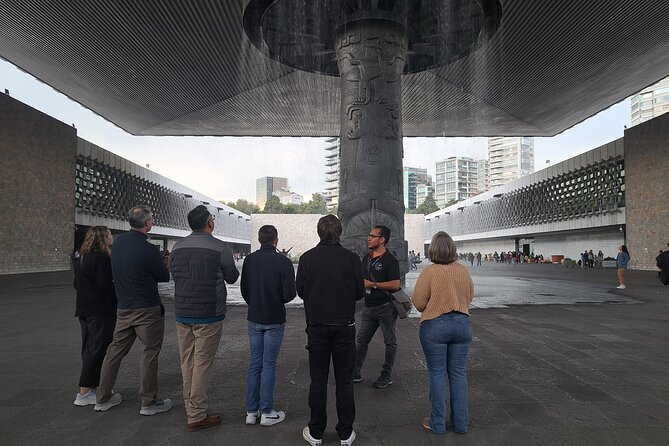
The maximum group size is 15, which is much more manageable than a large coach-style museum visit. A smaller group gives the guide a better chance to answer questions, check that everyone can hear, and adjust the pace when an object catches your interest.
Some reported groups were as small as two or three people. You should not assume every departure will be that intimate, but the 15-person limit still promises a more personal setting than a large tour.
Small groups are especially useful in this museum because you may need to pause in front of an object, look at a map, or ask for a symbol to be explained again. A large crowd can turn that into a struggle. Here, the format is designed for conversation.
The experience is offered in English and includes admission and a guide. Signs are mainly in Spanish, with only some English translations, so English-speaking visitors who do not read Spanish will gain a great deal from the live explanation. Even if you can read Spanish, the guide adds context that labels alone cannot provide.
Three hours means highlights, not every gallery
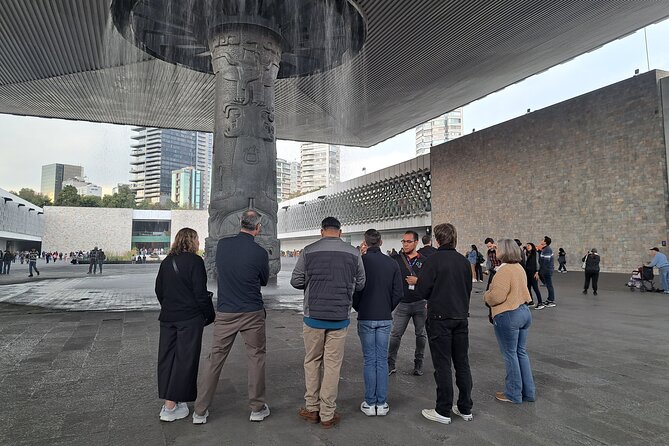
The biggest practical limitation is time. In three hours, you see only a portion of the museum. One account estimated that about three quarters of the collection remained unseen after the guided route.
That is not necessarily a fault. A three-hour tour has to choose. A good introduction should leave you with the main structure of the subject rather than exhaust you with every room. Still, you should set your expectations correctly.
If you want to browse on your own afterward, consider the start time. A 2 p.m. departure was described as less crowded than the morning, but the museum closed at 5 p.m., leaving no time for independent exploration after the tour. A morning or earlier start may suit you better if you want both the guided route and extra time alone.
I would treat the tour as the first part of a museum visit, not the entire visit, if you have a strong interest in archaeology. Afterward, you can return to the galleries that match your interests, though the available time depends on museum hours and the start time you choose.
Is $98.57 a fair price?
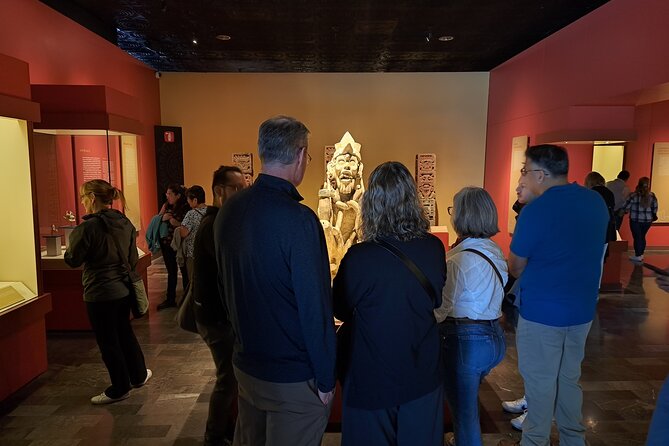
At $98.57 per person, this is not a budget museum entry. The fee includes the admission ticket and guide, but not tips or lunch. The real question is how much value you place on interpretation.
If you enter alone, you may save money but spend much of your visit working out what belongs where. The museum is enormous, and many signs are in Spanish. You might pass famous objects without understanding their role, or read isolated facts without seeing the sequence of events.
This tour makes more sense financially if you are visiting Mexico City for a short stay, prefer learning through conversation, or want an English-speaking expert to select the most important material. It can also be good value for a family, since keeping two teenagers interested for three hours is a real achievement.
It is less compelling if you already have strong background in Mesoamerican archaeology, speak Spanish well, and enjoy spending several hours reading every label at your own pace. In that case, you may prefer buying admission and exploring independently.
Tips are not included, so budget separately if you feel the guide earned one. Lunch is also on your own, and no meal is part of the three-hour visit.
Meeting point and practical planning
The tour begins and ends at the National Museum of Anthropology, at Av. Paseo de la Reforma s/n in the Chapultepec area of Mexico City. It is near public transportation, so you can plan your arrival without arranging a separate hotel transfer.
You receive confirmation when booking. Because one isolated account reported tickets that could not be downloaded and had to be purchased again at the entrance, I would check your confirmation before setting out and contact the provider promptly if the ticket details look incomplete. That problem does not match the large body of positive feedback, but it is worth preventing.
The activity allows service animals, and most people can participate. The group can reach a maximum of 15. You should expect a museum visit that involves standing and walking for much of the three hours, although no specific accessibility details beyond the information above are provided.
Free cancellation is available up to 24 hours before the start time for a full refund. Changes or cancellations inside that 24-hour window are not accepted for a refund, and the cut-off uses local Mexico City time. The experience also requires a minimum number of participants, so if the provider cancels for that reason, you are offered another date or experience, or a full refund.
Who will get the most from this visit
I would choose this tour if you want a strong introduction to Mexico’s ancient cultures without spending days studying the museum by yourself. It suits first-time visitors to Mexico City, English speakers who want help with Spanish-only labels, and anyone who prefers stories and questions to silent browsing.
Families may appreciate the interactive format, especially if young people are willing to look closely and answer questions. Solo visitors also fit the format well, since the guide provides company and structure without requiring you to join a huge group.
The tour is also a good match for visitors who care about how history is assembled. The attention to archaeology, evidence, symbols, and the limits of what can be proved gives the experience more substance than a simple list of famous artifacts.
I would hesitate only if you want to see every gallery, dislike a fixed route, or have limited interest in pre-Hispanic history. Three hours is long enough to require energy and attention, but too short to cover the entire collection.
Should you book the Anthropology Museum tour?
Yes, if you want the museum to make sense rather than merely look impressive. The strongest reason to book is the combination of an enormous collection, limited English signage, and guides who explain connections between objects instead of rushing past them.
Book it as a focused introduction, then allow extra time for independent exploration if your schedule permits. Check the ticket confirmation, choose your start time carefully, and remember that the $98.57 cost pays for access plus interpretation.
If you prefer to wander alone and already understand the subject, save the money and take your time. For most first-time visitors, though, the guide is what turns a vast museum into a readable story.
FAQ
Where does the tour begin and end?
The tour begins at the National Museum of Anthropology on Av. Paseo de la Reforma in the Polanco and Chapultepec area of Mexico City. It ends back at the same meeting point.
How long does the experience last?
The museum tour lasts approximately three hours.
Is museum admission included?
Yes. The ticket and guide are included in the listed price of $98.57 per person.
Is the tour offered in English?
Yes. The experience is offered in English, and guides such as Jorge and Delta are described as providing clear English explanations.
How many people can join the tour?
The maximum group size is 15 people. Some departures may be smaller, but a very small group is not guaranteed.
Can I cancel for a full refund?
Yes. You can cancel at least 24 hours before the start time for a full refund. Cancellations or changes made less than 24 hours before the start time are not refunded.
Does the tour cover the entire museum?
No. The three-hour route focuses on highlights, including major works such as the Sun Stone and Pakal Sarcophagus. You may want extra time to see galleries not included in the guided route.
New on the Mexico City list
- Day of the Dead Tour in San Andres Míxquic From Mexico City★ 3.7 · 52 reviews
- Half-Day Tour to Teotihuacan Pyramids from Mexico City★ 5.0 · 53 reviews
- Xochimilco floating gardens, Coyoacan and UNAM murals★ 4.0 · 53 reviews
- Guided Tour of Coyoacan and Leon Trotsky Museum★ 5.0 · 53 reviews
- Gay Side of History through Plazas & Temples★ 4.5 · 53 reviews
- Flavors of Mexico City: A Tasty Urban Expedition★ 4.5 · 53 reviews
- Butterfly Monarch Tour from Mexico City★ 5.0 · 53 reviews
- From Mexico City: Cholula Pyramid & Puebla Small Group Tour★ 4.6 · 54 reviews
Mexico City Tours, compared.
Teotihuacan, Guadalupe Shrine & Tlatelolco Day Tour with Lunch
Read our review →
Xochimilco, Coyoacan and Frida Kahlo with Optional Lunch
Read our review →
Balloon flight + Breakfast in cave + Pyramids + Pick up CDMX.
Read our review →
Teotihuacan pyramids morning or afternoon without tourist traps
Read our review →
Teotihuacan Early Access Guided Tour with optional Lunch
Read our review →
Balloon flight + pick up in CDMX + Breakfast in Cave + Pyramids
Read our review →
Balloon Flight + Cave Breakfast + Pick Up from CDMX or We Fly
Read our review →
Teotihuacan, Tlatelolco & Guadalupe Shrine Tour
Read our review →Browse the lists this tour appears in